
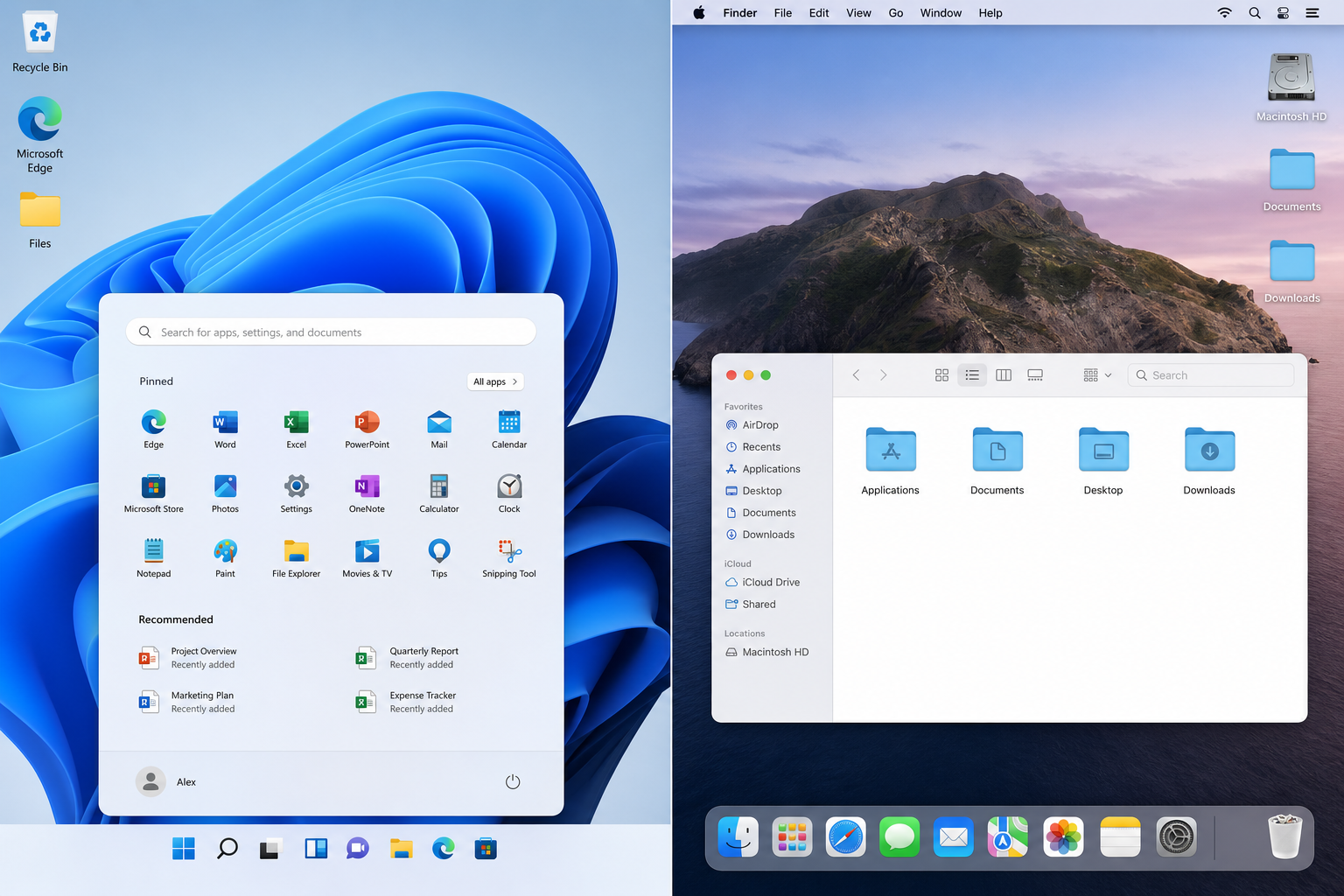
The core Windows vs macOS decision comes down to this: Windows offers broader hardware choice, deeper customization, and the best gaming library, while macOS trades flexibility for a tightly controlled ecosystem built around Apple’s own hardware. Both are mature, modern graphical operating systems, but they solve different problems for different people, and the right pick depends on how you work, what software you rely on, and what hardware you already own.
This guide breaks down the practical differences that actually affect small business IT, home power users, and sysadmins making a purchasing decision — not just surface-level opinions about which desktop looks nicer.
What Is Windows?

Windows is Microsoft’s family of graphical operating systems, first released in 1985 and now built around the Windows NT kernel that powers every modern release, including Windows 11. It is the operating system installed on the largest share of the world’s desktops and laptops, largely because it runs on hardware from dozens of manufacturers rather than a single vendor.
Because Windows isn’t tied to one hardware maker, IT teams can buy machines across a huge price range — from budget office PCs to high-end workstations — and license the operating system separately when needed. That flexibility is one of the biggest practical differences in any Windows vs macOS comparison.
Core Windows Features
-
Interface: The Start menu, Taskbar, and window snapping are designed for fast multitasking and keyboard-and-mouse workflows.
-
Gaming: The overwhelming majority of PC games, including titles using DirectX, are built and optimized for Windows first.
-
Productivity suite: Microsoft Word, Excel, and PowerPoint are native to the Windows ecosystem, though also available on macOS.
-
Customization: Themes, taskbar layout, registry tweaks, and third-party shell tools give users deep control over how the system looks and behaves.
-
Hardware compatibility: Windows supports an enormous range of components, printers, and peripherals from third-party manufacturers.
What Is macOS?
macOS is Apple’s proprietary operating system, built on a Unix foundation and designed exclusively for Apple’s own Mac hardware. It was originally released as Mac OS X in 2001, later shortened to OS X, and then rebranded as macOS. Apple controls both the hardware and software stack, which is the single biggest structural difference when you compare Windows vs macOS side by side.
Because macOS only ships on Apple-made machines, you don’t buy a standalone macOS license the way you buy Windows — it comes bundled with the Mac itself, and upgrades are typically free downloads through the App Store for supported models.
Core macOS Features
-
Interface: The Dock, Mission Control, and Spotlight search give macOS a clean, consistent visual language across apps.
-
Apple ecosystem integration: Handoff, AirDrop, and iCloud let Mac users move seamlessly between iPhone, iPad, and Mac.
-
Productivity suite: Pages, Numbers, and Keynote are Apple’s built-in alternatives to Word, Excel, and PowerPoint.
-
Security: Gatekeeper, sandboxing, and a more closed app-distribution model reduce (but don’t eliminate) exposure to malware.
-
Accessibility: Built-in tools like VoiceOver are deeply integrated at the system level.
Windows vs macOS: The Core Differences

Once you look past the interface, the Windows vs macOS decision usually comes down to five practical categories: user interface philosophy, hardware and software compatibility, gaming, security model, and how you pay for the OS. Each one has real consequences for cost and day-to-day usability.
User Interface and Workflow
Windows favors flexibility — multiple ways to do the same task, extensive keyboard shortcut customization, and a taskbar you can rearrange freely. macOS favors consistency — one dock, one menu bar, and an interface Apple keeps deliberately uniform across all its apps. Neither approach is objectively better; it’s a question of whether you want control or consistency.
Hardware and Software Compatibility: Windows vs macOS
This is where the Windows vs macOS gap is widest. Windows runs on hardware from Dell, HP, Lenovo, ASUS, and countless custom-built PCs, and supports a vast range of peripherals, GPUs, and legacy software going back decades. macOS runs only on Apple hardware, so your hardware options are limited to whatever Apple currently sells — but in exchange you get a smaller, more predictable set of configurations that Apple tests and optimizes tightly.
For businesses running specialized line-of-business software, industry tools, or older Windows-only applications, this compatibility gap is often the deciding factor before interface preferences even come into play.
Gaming Performance
Windows remains the dominant gaming platform. Most AAA titles, esports games, and modding communities are built around DirectX and Windows-first development pipelines. macOS has improved gaming support in recent years, partly through Apple Silicon’s performance gains, but the available game library is still substantially smaller than what’s available on Windows.
Security Model
Both systems have matured significantly on security. Windows ships with Windows Defender built in, along with features like Windows Hello and TPM-backed encryption on modern hardware. macOS relies on Gatekeeper, sandboxing, and a more curated software distribution model through the App Store. In practice, security on either platform depends heavily on keeping the OS updated and avoiding untrusted downloads — the underlying architecture matters less than patching discipline.
Pricing and Licensing: The Most Overlooked Windows vs macOS Difference
Here’s the practical difference that often gets skipped in a Windows vs macOS comparison: macOS is never sold as a standalone product. You cannot buy a macOS license separately — it’s bundled into the price of Apple hardware, and you can only run it legally on a genuine Mac.
Windows works differently. You can buy a genuine Windows license as a standalone product and install it on a PC you already own, a custom build, or a refurbished machine. That means the total cost of “switching to Windows” is often just the price of the license, not a whole new computer. For example, Windows 11 Pro OEM is available as a genuine activation key with instant email delivery, which is significantly cheaper than buying new hardware just to get a licensed OS.
This licensing flexibility is a major reason IT departments and home users who already own PC hardware lean toward Windows: you’re paying for the software, not re-buying the machine.
Similarities Between Windows and macOS
Despite their differences, both platforms share a common foundation:
-
Both support true multitasking across multiple running applications.
-
Both have mature networking stacks supporting standard protocols and enterprise VPNs.
-
Both offer official app stores for discovering and installing software safely.
-
Both use hierarchical file systems for organizing files and folders.
-
Both offer solid hardware compatibility, though Windows supports a far wider range of third-party components.
Windows vs macOS: Quick Comparison
The table below summarizes how the two systems differ on the fundamentals IT buyers care about most.
-
Developer: Windows is developed by Microsoft; macOS is developed by Apple.
-
First released: Windows launched in 1985; macOS (as Mac OS X) launched in 2001.
-
Hardware: Windows runs on PCs from many manufacturers; macOS runs only on Apple Mac hardware.
-
File systems: Windows primarily uses NTFS and FAT; macOS primarily uses APFS and HFS+.
-
Package management: Windows uses MSI and custom installers; macOS uses the built-in macOS installer and App Store.
-
Update management: Windows uses Windows Update; macOS uses Software Update.
-
Native APIs: Windows uses Win32 and the NT API; macOS uses Cocoa and related Apple frameworks.
According to StatCounter’s global desktop OS tracking, Windows holds roughly 63% of the worldwide desktop operating system market, with macOS trailing at around 15% — a gap that reflects Windows’ broader hardware and price-point coverage rather than a simple quality difference.
Which Should You Choose: Windows or macOS?

Choosing between Windows and macOS should start with what you already own and what software you depend on, not brand loyalty. If you need broad hardware choice, a large software and gaming library, and the ability to license the OS independently of the machine, Windows is the more flexible and often more cost-effective route. If you’re already inside the Apple ecosystem and value tight hardware-software integration over configurability, macOS remains a strong, well-supported option.
For small business IT and sysadmins managing multiple machines, the licensing model matters as much as the interface. Windows lets you standardize on genuine licenses across a mixed fleet of hardware — old and new, desktop and laptop — without being locked into one manufacturer’s pricing.
Buying a Genuine Windows License
If you’ve decided Windows fits your setup better, the next step is getting a legitimate license rather than an unverified key from an unclear source. Genuine keys activate directly through Microsoft’s servers, receive full security updates, and avoid the compliance risk of counterfeit or previously-banned keys. Shop Key Online offers verified Windows 11 Pro licenses with instant email delivery and official download links, which is the fastest way to license a new build or a machine you’re migrating from macOS or an older Windows version.
Before buying, check your hardware meets Microsoft’s minimum requirements, including TPM 2.0 support for Windows 11, and back up your files if you’re migrating from another OS or upgrading in place.
Frequently Asked Questions
How do I download Windows after buying a license key?
After purchase, you’ll receive an official Microsoft download link along with your activation key by email, usually within minutes. Use that link to download the Windows 11 installer or media creation tool directly from Microsoft’s servers rather than a third-party mirror.
How do I install Windows on a new or existing PC?
Run the downloaded installer, choose a clean install or in-place upgrade depending on your situation, and follow the setup wizard through disk selection, region, and account configuration. Have your product key ready to enter during setup, or activate afterward from Settings.
How do I activate Windows with a purchased key?
Go to Settings > System > Activation, select “Change product key,” and enter your 25-character key exactly as provided. Activation typically completes within seconds if your PC has an internet connection and the key hasn’t been used elsewhere.
Can I install macOS on a non-Apple PC?
Officially, no — Apple licenses macOS to run only on genuine Mac hardware, and it isn’t sold as a separate retail product. Unofficial “hackintosh” installations exist but fall outside Apple’s supported use and licensing terms.
Is Windows or macOS better for gaming?
Windows is the stronger choice for gaming, since the majority of PC titles, including major AAA releases, are developed and optimized for DirectX on Windows first. macOS gaming has improved but still has a considerably smaller library.
Do I need to buy Windows separately if I already own a PC?
Yes, unless your PC came with Windows pre-installed and already activated. If you built your own PC or are reinstalling from scratch, you’ll need a genuine Windows license key to activate the OS and receive full updates and support.
What happens if I use an unverified or counterfeit Windows key?
Your installation may fail to activate, lose activation after an update, or be blocked entirely if Microsoft flags the key as invalid. Buying from a verified reseller avoids this risk and ensures your license is tied to a legitimate Microsoft account.
