

The Windows gaming handheld Arc chip moment has officially arrived. Intel’s Arc G-series processors — built on the brand-new Xe3 architecture — are now shipping in dedicated handheld gaming PCs, and the early numbers suggest AMD’s grip on this market is about to be seriously challenged. Whether you’re eyeing an MSI Claw, a new Lenovo Legion Go successor, or something from ASUS, this guide covers everything: raw performance, battery endurance, how XeSS 3 changes the equation, and what Windows licence you’ll need to get the best out of your new device.
What Is the Intel Arc G-Series for Handhelds?
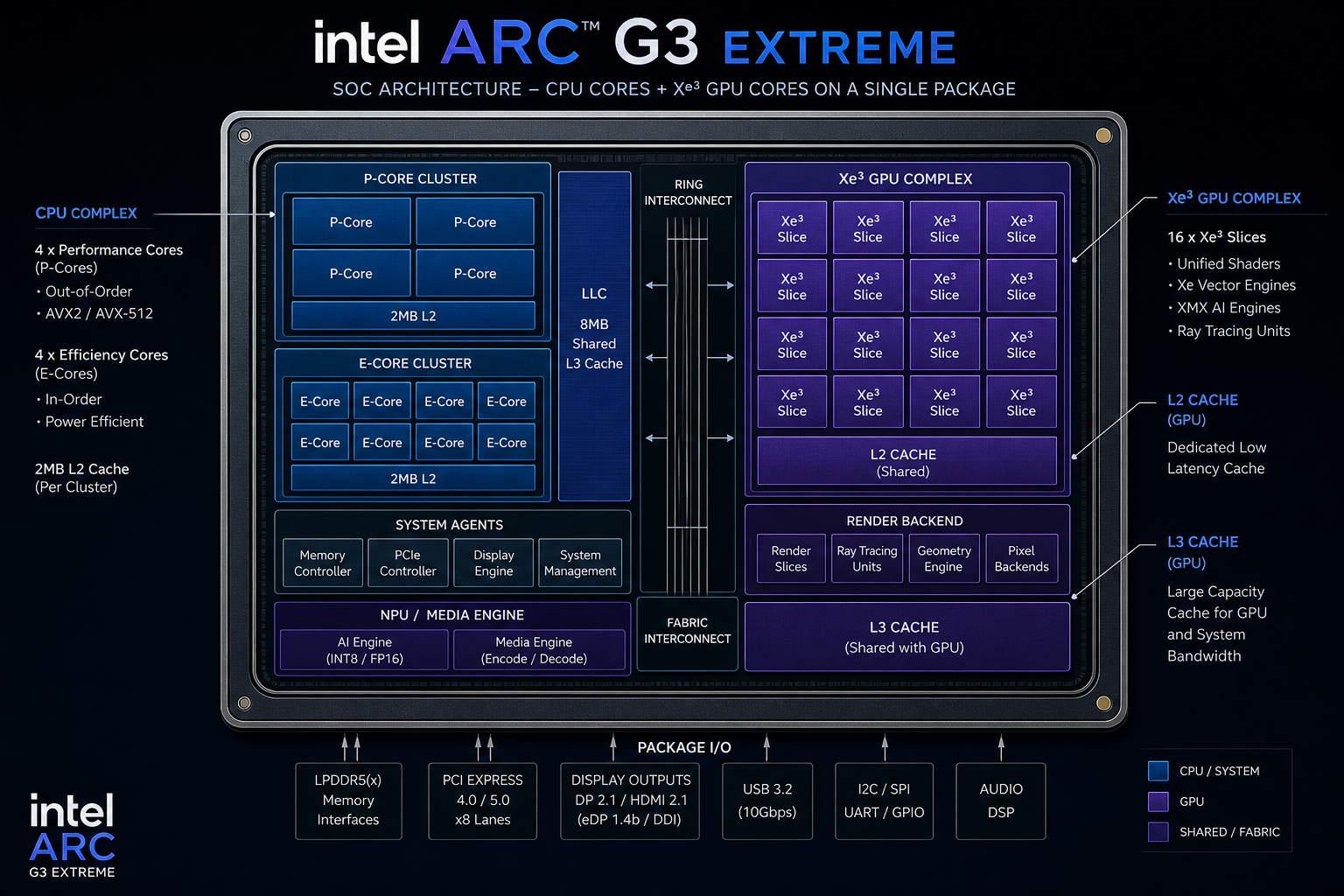
Intel’s Arc G-series is not a repurposed laptop chip — it is a purpose-built SoC designed specifically for handheld gaming PCs. Two variants have launched: the Arc G3 and the higher-tier Arc G3 Extreme. Both share a 14-core CPU layout — two high-performance P-cores, eight efficiency E-cores, and four low-power LP E-cores — tuned around the strict thermal and battery constraints of a handheld form factor.
On the graphics side, the Arc G3 uses an Arc B370 GPU with 10 Xe3 cores, while the Arc G3 Extreme steps up to an Arc B390 with 12 Xe3 cores, boosting to a 4.7 GHz maximum turbo frequency. The entire SoC supports hardware ray tracing, Intel’s XeSS 3 AI upscaling suite (combining XeSS Super Resolution, Multi-Frame Generation, and Xe Low Latency), and up to 12 PCIe lanes for fast storage.
Intel Arc G3 vs AMD Radeon 890M: The Performance Fight
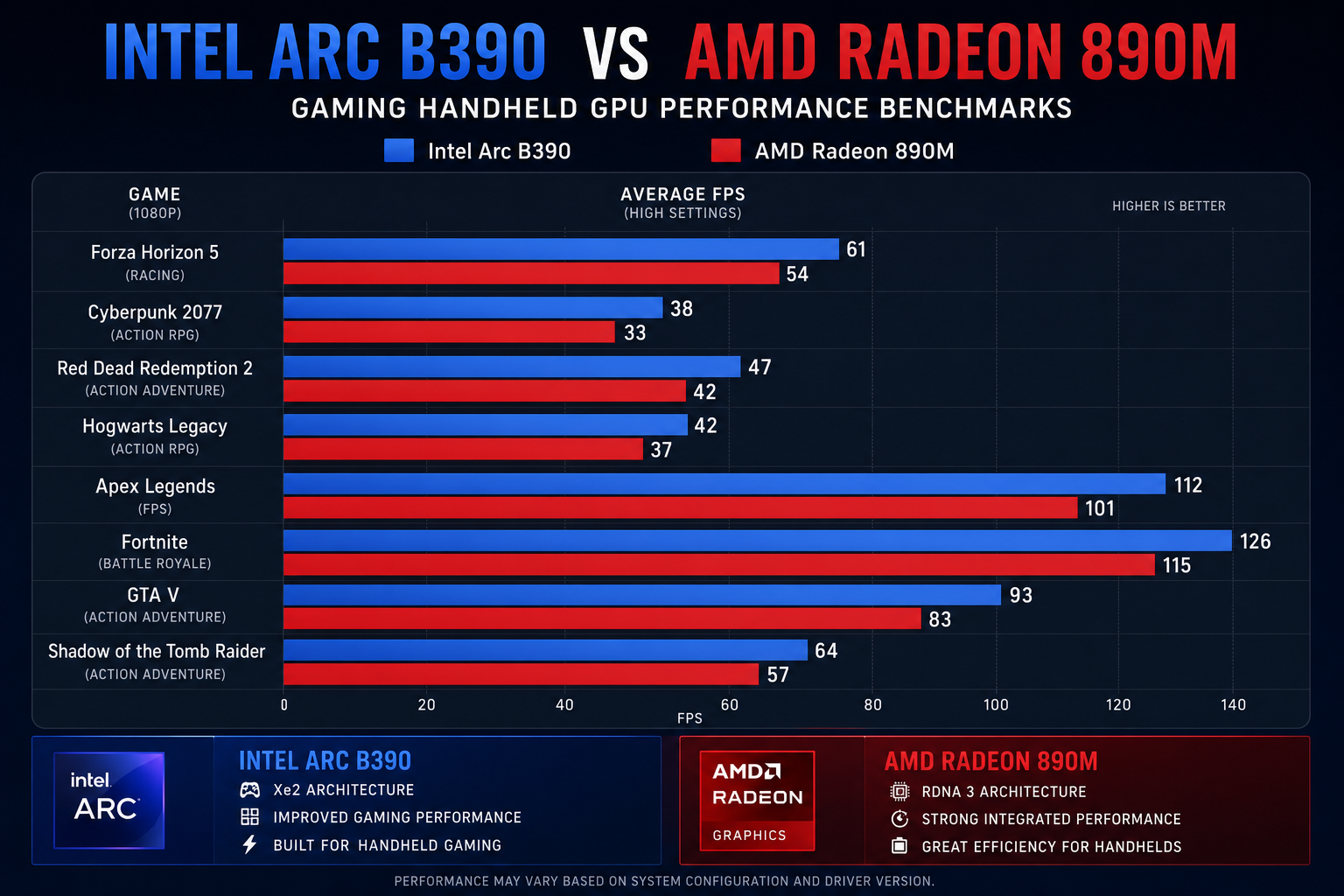
AMD’s Ryzen Z2 Extreme with Radeon 890M has been the dominant chip in premium Windows handhelds since 2025 — but the Intel Arc gaming handheld CPUs flip the leaderboard. According to Intel’s own benchmarks, the Arc B390 GPU inside the G3 Extreme delivers up to 73% faster graphics performance than the Radeon 890M in comparable workloads. Independent benchmark leaks corroborate the claim, with the Arc G3 Extreme scoring roughly 25% above the Ryzen Z2 Extreme in synthetic GPU tests.
In practical gaming terms, titles like Cyberpunk 2077, Elden Ring, and Black Myth: Wukong become significantly more playable at the handheld’s native 1080p or 800p screen resolution, especially with XeSS Super Resolution engaged. XeSS 3’s Multi-Frame Generation feature — the handheld-equivalent of DLSS Frame Generation — can double rendered frame rates at the cost of minimal latency, something AMD’s FSR 3 competes with but which XeSS 3 executes with hardware-level efficiency on Arc silicon.
The key caveats: game compatibility with XeSS 3 is growing but not universal at launch, and driver maturity is something AMD has a multi-year head start on. Intel Arc’s drivers have improved dramatically since the discrete GPU debut in 2022, but edge-case bugs in older titles remain a realistic concern for early adopters.
Battery Life: Does the Arc G-Series Go the Distance?
Battery life is where Arc G3 handheld devices make their most compelling pitch against the competition. Intel’s Lunar Lake architecture — the underlying platform for the G-series — was engineered from the ground up for power efficiency, placing CPU and GPU memory on the same package to slash bandwidth power draw. Intel claims nearly 20 hours of video-playback battery life and positions the chip as delivering “exceptional battery life without compromise” in gaming use.
Real-world gaming numbers are more modest, as they always are. Early hardware previewed at Computex 2026 with 80 Wh batteries showed figures in the region of 3–5 hours under sustained gaming load at 15–25 W TDP settings, which is competitive with AMD-based rivals at equivalent performance targets. The MSI Claw — already shipping with earlier Lunar Lake silicon — topped two hours in PCMark’s demanding gaming battery benchmark, a result that improves meaningfully at the lower TDP settings most handheld gamers actually use day to day.
For commuters, students, and travelling gamers, the difference between 2.5 hours and 4 hours at medium settings is enormous. The efficiency story around the Arc handheld GPU platform looks genuinely competitive once you account for real-world TDP throttling.
Which Windows 11 Gaming Handhelds Use the Arc G-Series?

Several major OEMs announced or confirmed Arc G-series models at Computex 2026. Here is a quick overview of the devices to watch:
-
MSI Claw (Arc G3 Edition) — MSI has been an early Intel handheld partner; expect updated Claw models with the Arc G3 and G3 Extreme, building on the brand’s proven thermal design and 80 Wh battery.
-
ASUS ROG Ally (Arc variant) — ASUS is expected to offer an Arc G3 option alongside its AMD-based SKUs, giving buyers a direct side-by-side choice at retail.
-
Lenovo Legion Go successor — Lenovo’s large-screen Legion Go platform is a natural fit for the G3 Extreme’s higher performance envelope; details are pending an official announcement.
-
Upcoming third-party Windows handhelds — Smaller brands including Aokzoe, OneXPlayer, and GPD have all indicated Arc G-series designs are in the pipeline.
All of these devices ship with Windows 11 Home or Windows 11 Pro as standard, which is the only OS that natively supports Intel’s Arc drivers, XeSS, and the Intel AI Boost NPU.
Why Your Windows Licence Matters on a Handheld
Most gaming handhelds ship with Windows 11 Home pre-installed — perfectly fine for gaming and streaming. However, if you plan to use your device for remote work, domain join, BitLocker full-disk encryption, or Remote Desktop host functionality, you will want Windows 11 Pro. Pro also gives you access to Hyper-V and advanced Group Policy settings that power users value.
The good news is that upgrading your licence does not require reinstalling Windows. You simply enter a new product key and your existing installation activates instantly. ShopKeyOnline stocks genuine Windows 11 Pro OEM keys from €15.95 — the most cost-effective way to make sure your handheld is fully unlocked before you take it on the road. If you also want a productivity suite for those commute hours, the Windows 11 Pro + Office 2021 Pro Plus bundle (€36.90) bundles both at a significant saving versus buying separately.
Arc G3 Handheld: What XeSS 3 Actually Means for Gamers
XeSS 3 is arguably the biggest reason to pay attention to the Intel Arc gaming handheld platform beyond raw rasterisation numbers. It bundles three technologies:
-
XeSS Super Resolution — AI-driven temporal upscaling that renders at a lower internal resolution and reconstructs a sharp, high-resolution output. Performance-mode XeSS at 540p internal can hit smooth 60 fps in demanding games at 1080p output.
-
XeSS Multi-Frame Generation — Intel’s answer to DLSS Frame Generation; generates additional synthetic frames between rendered frames using AI, effectively multiplying visible frame rates. Unlike AMD’s FSR 3 frame generation, it does not require an AMD GPU.
-
Xe Low Latency — A latency-reduction pipeline (comparable to NVIDIA Reflex) that cuts input lag, crucial for fast-paced handheld gaming where every millisecond of controller response matters.
Taken together, XeSS 3 lets a 15 W handheld GPU punch well above its thermal weight — the practical upshot is that many titles unplayable at native resolution on rival hardware become genuinely fluid experiences on an Arc G3 handheld.
Intel Arc G3 vs Steam Deck: Should You Ditch Valve?
The Steam Deck OLED remains excellent value — especially at its price point — but runs SteamOS on AMD RDNA 3 graphics, and its driver ecosystem is Linux-first. Windows gaming handhelds with Arc G-series silicon offer substantially higher GPU performance (Intel claims up to 30% faster gaming versus unnamed competition in the 15 W class), a fuller Windows 11 software ecosystem, and the ability to run any PC game launcher, not just Steam.
The trade-off is price and complexity. Arc G-series handhelds are expected to start in the £700–£900 range in the UK, versus the Steam Deck OLED’s £479 entry point. Battery life on SteamOS is also better optimised than Windows at equivalent hardware, so casual gamers on a budget may still prefer Valve’s offering. For anyone who wants a true Windows gaming handheld with the latest Intel Arc GPU inside, however, the G-series marks a genuine step change.
Should You Buy Now or Wait?
The honest answer depends on your timeline. The Windows gaming handheld Arc chip ecosystem is brand new: driver maturity will improve over the next 6–12 months, more XeSS 3-compatible game titles will ship, and OEM designs will benefit from customer feedback. If you are happy being an early adopter and want maximum GPU performance today, the Arc G3 Extreme devices are compelling. If you can wait until late 2026, you will enjoy a more mature software stack and likely slightly lower prices as competition intensifies.
Whatever you decide, make sure the Windows 11 licence on your device is legitimate and fully activated — some grey-market handhelds ship with unactivated or OEM-locked keys that cause problems down the line. A clean, genuine licence from a trusted retailer removes that headache entirely.
FAQ
What is the Intel Arc G-series chip inside Windows gaming handhelds?
Intel’s Arc G-series is a purpose-built SoC for handheld gaming PCs, distinct from Intel’s laptop or desktop processors. It combines a 14-core CPU (P-cores, E-cores, and low-power LP E-cores) with Arc Xe3 graphics — Arc B370 in the standard G3 and Arc B390 in the G3 Extreme — all on a single efficient package optimised for the 15–25 W thermal envelope of a handheld device.
How does Arc G3 performance compare to AMD’s Ryzen Z2 Extreme?
Intel claims the Arc B390 GPU in the G3 Extreme is up to 73% faster than the AMD Radeon 890M found in the Ryzen Z2 Extreme. Independent benchmark leaks suggest a roughly 25% GPU lead in synthetic tests. Real-world gaming gains will vary by title, driver version, and TDP setting, but the Arc G3 Extreme is consistently faster in early testing.
What battery life can I expect from an Arc G3 gaming handheld?
Intel claims up to nearly 20 hours of battery life in light usage scenarios. Under sustained gaming load at 15–25 W, expect 3–5 hours with a large 80 Wh battery, which is competitive with AMD-based rivals at equivalent performance settings. Lowering the TDP cap to 10–15 W extends battery life significantly, especially for less-demanding indie titles or emulation.
Do I need Windows 11 Pro on my gaming handheld?
Windows 11 Home covers all gaming needs — it runs all Arc drivers, XeSS 3, and the Intel AI Boost NPU natively. You only need Pro if you require BitLocker encryption, domain join, Remote Desktop host, or Hyper-V. If those features matter to you, a genuine Windows 11 Pro key from ShopKeyOnline is the most affordable upgrade route.
What is XeSS 3 and does it make a big difference on a handheld?
XeSS 3 is Intel’s AI upscaling and frame generation suite built into Arc G-series silicon. It combines XeSS Super Resolution (temporal upscaling for higher effective resolution), Multi-Frame Generation (synthetic frame insertion for smoother gameplay), and Xe Low Latency (input lag reduction). On a thermally constrained handheld GPU, XeSS 3 can make the difference between a stuttery 30 fps and a smooth 60 fps in many modern titles.
Which Windows 11 gaming handhelds will ship with Arc G-series chips?
Confirmed or strongly expected models include the MSI Claw (Arc G3 Edition), an ASUS ROG Ally Arc variant, and upcoming devices from Lenovo, OneXPlayer, Aokzoe, and GPD. Most are expected to reach retail in the second half of 2026, with prices likely starting around £700–£900 in the UK for Arc G3 models.
